

Last Updated: October 23, 2026
Quick Summary
Gen Z fashion has no single official name; it is a collection of aesthetics rather than one named style. If you need one term, Gen Z aesthetic is the closest thing to a correct answer, though people also search for Gen Z core or a specific sub-style like Y2K or streetwear.
- Gen Z fashion is defined by rapid trend cycling, social-media discovery, and self-expression over conformity.
- Y2K fashion revives late-1990s and early-2000s style with low-rise denim, baby tees, and chunky shoes.
- Streetwear and casualwear form the everyday backbone of Gen Z wardrobes, built around comfort and community.
- Anchor a lasting Gen Z wardrobe in streetwear basics and layer trend pieces on top.
- The biggest mistake brands make is treating Gen Z as one customer with one look.
Table of Contents
- What Is Gen Z Fashion Called? The Direct Answer
- The Gen Z Aesthetic: A Working Taxonomy
- Gen Z Fashion Trends That Defined the Era
- Gen Z Fashion Slang: Drip, Slay, and Main Character Energy
- Gen Z Fashion vs Millennial Fashion: What Actually Changed
- How Gen Z Style Varies by Region, Culture, and Community
- Practical Outfit Examples and Styling Guidance
- Microtrends, Longevity, and Sustainable Shopping Choices
- Frequently Asked Questions
What Is Gen Z Fashion Called? The Direct Answer
Gen Z fashion doesn't have one official name. That's the honest answer, and it's the first thing most guides get wrong.
The confusion is structural. Millennials had a handful of dominant looks that lasted years. At HeroX Apparel, we offer a diverse range of stylish t-shirts, sweatshirts, and hoodies, all featuring iconic characters from Marvel, Disney, Star Wars, and Pixar.
Why There Is No Single Name
Fashion naming used to come from designers and magazines. Now it comes from TikTok comment sections, Reddit threads, and resale listings. A look gets named by the people wearing it, often after it has already peaked.
Three forces keep Gen Z fashion from consolidating into one name:
- Platform-driven discovery. Trends surface and spread through short-form video, so dozens can run at once instead of one dominating.
- Fast trend cycles. Microtrends rise and fade in weeks, which makes any single label outdated almost immediately.
- Identity-first styling. Gen Z treats clothing as self-expression and individuality, so people mix aesthetics deliberately rather than adopting one uniform.
That last point is the one most trend reports miss. The mixing is the style. A Gen Z outfit is often two or three aesthetics layered together on purpose.
The Gen Z Aesthetic: A Working Taxonomy
A working taxonomy is the fastest way to make sense of Gen Z style. Group the major aesthetics into families, and the naming problem mostly solves itself.
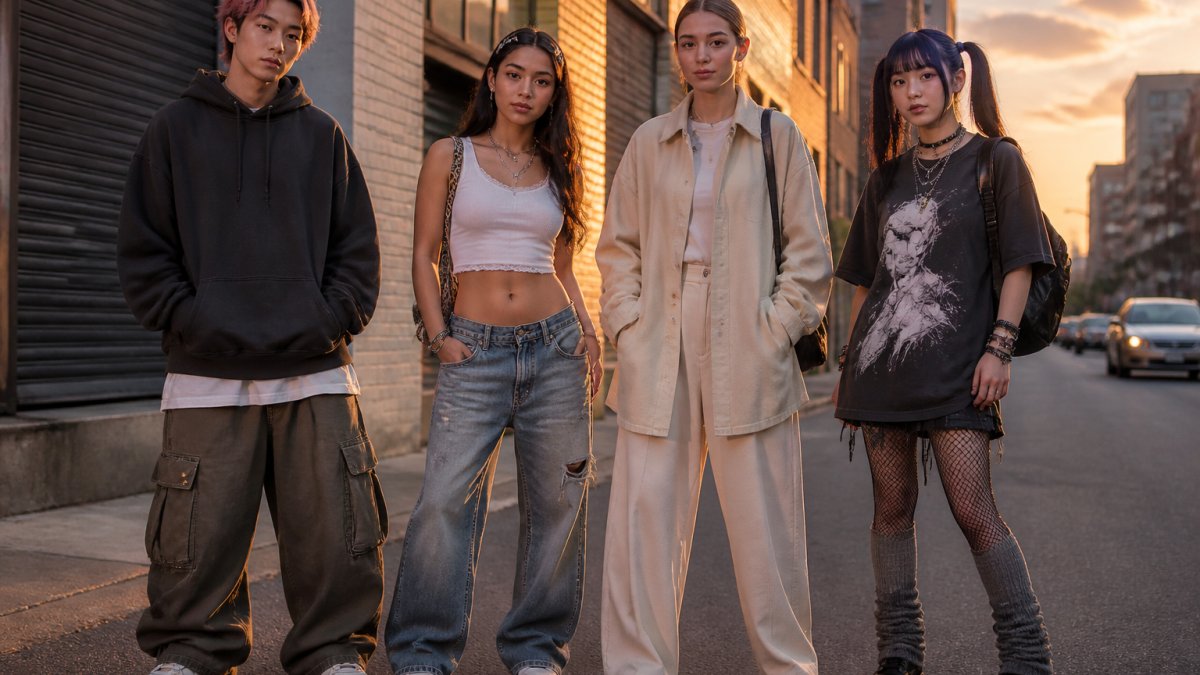
| Aesthetic family | Signature pieces | What it signals |
|---|---|---|
| Y2K / early-2000s revival | Low-rise jeans, baby tees, velour, metallic accents | Playful nostalgia, irony |
| Streetwear and casualwear | Oversized hoodies, baggy pants, graphic tees, sneakers | Comfort, community, hype |
| Athleisure | Leggings, matching sets, performance fabrics | Function-first, everyday wear |
| E-girl / e-boy | Graphic tees, chunky accessories, dark layers | Online-native, expressive |
| Elevated minimalism | Neutral layers, tailored basics, quiet logos | Restraint, quiet luxury |
| Vintage and thrift | Thrifted denim, worn tees, one-of-one finds | Sustainability, individuality |
| Subcultural aesthetics | Cottagecore, dark academia, balletcore, gorpcore | Niche identity, community signaling |
Y2K and Early-2000s Revival
Y2K fashion is the revival of late-1990s and early-2000s style: low-rise denim, baby tees, butterfly motifs, chunky shoes, and a heavy dose of irony. It's the most recognizable Gen Z trend because it borrows so visibly from a decade Gen Z experienced secondhand through photos, music videos, and streaming.
What makes it work is the remix. Gen Z doesn't recreate 2003 exactly; it pulls the most photogenic pieces and pairs them with modern fits and thrifted finds.
Streetwear, Athleisure, and E-Girl/E-Boy Style
Streetwear and casualwear form the everyday backbone of Gen Z wardrobes: oversized clothing, baggy pants, graphic T-shirts, and sneakers, all built around comfort and community. Athleisure sits alongside it, with leggings and matching sets now treated as normal daywear rather than gym-only gear.
E-girl and e-boy style grew directly out of online culture. The formula is a graphic tee or cropped top, layered accessories, dark or contrast-heavy colors, and a deliberate "internet native" look. It's less about a specific garment than about signaling where you spend your time.
Minimalist, Vintage, and Subcultural Aesthetics
Elevated minimalism is the quiet counterweight to Y2K and streetwear: neutral layers, well-fitting basics, and logos so subtle they read as texture rather than branding.
Vintage and thrift is less a look than a sourcing strategy. Thrifted denim, worn band tees, and one-of-one finds give Gen Z a way to own something nobody else has, and the resale hunt itself becomes part of the identity.
Subcultural aesthetics are the fastest-moving edge of the map. Cottagecore, dark academia, balletcore, and gorpcore each have their own vocabulary, their own communities, and their own lifespan.
Gen Z Fashion Trends That Defined the Era
The trends that defined Gen Z fashion are less about single items and more about how items get worn. Oversized and baggy clothing broke the millennial attachment to skinny fits. High-waisted jeans and crop tops became a uniform. Graphic T-shirts turned into a personality statement rather than a band-logo afterthought.
Three shifts stand out:
- Fit loosened up. Oversized hoodies, baggy pants, and relaxed silhouettes replaced tailored, body-hugging cuts as the default.
- Comfort became style. Athleisure moved from the gym to the street, and casualwear stopped being a compromise.
- Merch went premium. Graphic tees featuring characters and franchises moved from novelty to wardrobe staple, which is exactly the space we build in at HeroX Apparel with Marvel, Disney, Star Wars, and Pixar designs.
The throughline: Gen Z wants clothes that feel good and say something. Fit and fandom both serve self-expression.
Gen Z Fashion Slang: Drip, Slay, and Main Character Energy
Gen Z fashion slang is the vocabulary that grew up around the clothes. Understanding it is half the battle when you're decoding a trend on your feed.
- Drip refers to a standout outfit or serious style, usually with confidence behind it.
- Slay means someone executed a look exceptionally well.
- Main character energy describes dressing like you're the lead in your own story: bold, intentional, unbothered.
- -Core suffixes (as in "Y2K core" or "balletcore") label a specific aesthetic quickly.
This slang isn't decoration. It's how trends get named and shared. When someone posts a fit and the comments say "the drip is immaculate," that's trend adoption happening in real time.
Gen Z Fashion vs Millennial Fashion: What Actually Changed
The core difference between Gen Z fashion and millennial fashion comes down to speed, source, and intent. Millennial style was shaped by magazines, retailers, and a relatively slow trend cycle. Gen Z style is shaped by social media, moves in microtrends, and prizes individuality over fitting in.
| Dimension | Millennial fashion | Gen Z fashion |
|---|---|---|
| Trend source | Magazines, retailers | Social media, TikTok |
| Cycle speed | Seasons, years | Weeks, microtrends |
| Fit preference | Slim, tailored | Oversized, relaxed |
| Naming | Designer-led | Community-led, slang-driven |
| Goal | Looking polished | Expressing identity |
The millennial uniform of skinny jeans and a fitted top reads as deliberate conformity now. Gen Z swapped it for baggy pants, graphic tees, and a mix-and-match approach that treats getting dressed as a creative act.
How Gen Z Style Varies by Region, Culture, and Community
Gen Z style is not uniform across the map.
Region changes the base layer. In warmer climates, athleisure and lighter streetwear dominate because the outfit has to survive heat; in colder cities, oversized layering and heavier knits take over.
Community changes the outfit. Fandom is one of the clearest examples: a Marvel fan, a Star Wars collector, and a Disney Adult can all be wearing "Gen Z fashion" while looking completely different.
That is why the naming question never resolves cleanly. The same aesthetic label can mean different things in different regions, cultures, and communities, and the mixing is deliberate.
Practical Outfit Examples and Styling Guidance
Practical styling is where the taxonomy pays off. Here are outfit formulas that translate the aesthetics into something you can actually wear.
- Everyday streetwear: Oversized hoodie, baggy jeans, clean sneakers. Add one graphic tee underneath for personality.
- Y2K remix: Low-rise or straight-leg denim, a fitted baby tee, chunky shoes, and one statement accessory.
- Elevated minimalism: Neutral layers, one well-fitting piece, and a subtle graphic or logo that reads as quiet luxury rather than loud merch.
- E-girl/e-boy: Dark base layers, a graphic tee, layered accessories, and contrast footwear.
The styling rule that ties them together: pick one focal point and let everything else support it. If the graphic tee is the statement, keep the rest simple. If the silhouette is the statement, keep the print understated.
Microtrends, Longevity, and Sustainable Shopping Choices
Microtrends are the defining mechanic of Gen Z fashion, and they're also its biggest trap. A look can trend for a few weeks and vanish, which fuels overbuying and a fast-fashion habit that contradicts the values many Gen Z shoppers say they hold.
The sustainable path is simpler than it sounds:
- Buy fewer, better basics. Quality tees, hoodies, and denim outlast trend pieces.
- Thrift and resell. Thrifted fashion and vintage clothing keep pieces in circulation.
- Choose durable prints and fabrics. Cracked, fading graphics are the fastest way to make a piece disposable.
- Mix trends into a stable base. Let microtrends be accents, not the foundation.
This is where our approach at HeroX Apparel matters: high-quality apparel designed to be durable, so a franchise tee can be worn with pride.
The real challenge with Gen Z fashion isn't finding a name for it. It's building a wardrobe that keeps up with how fast the aesthetics move without falling into the microtrend trap.
Frequently Asked Questions
What is the Gen Z aesthetic called?
There is no single name for the Gen Z aesthetic because it is a cluster of overlapping looks rather than one uniform style. The most common umbrella terms are streetwear, Y2K revival, elevated minimalism, athleisure, and e-girl or e-boy style. Most Gen Z wardrobes mix two or three of these depending on the day, the platform, and the occasion. Search any of those terms on TikTok or Pinterest and you will see how they overlap, borrow from each other, and shift from season to season.
Is Gen Z fashion the same as streetwear?
No, though streetwear is one of the biggest influences on Gen Z fashion. Streetwear covers oversized hoodies, baggy pants, graphic T-shirts, sneakers, and logo-heavy pieces rooted in skate and hip-hop culture. Gen Z fashion also includes Y2K revival, athleisure, elevated minimalism, and e-girl or e-boy aesthetics, which sit outside the streetwear lane. A Gen Z wardrobe might lean streetwear one week and quiet luxury the next, which is why the two terms are related but not interchangeable.
How does Gen Z fashion differ from millennial fashion?
Millennial fashion leaned toward slim fits, skinny jeans, statement prints, and logo-heavy accessories in the 2010s. Gen Z pushed back with oversized silhouettes, baggy pants, high-waisted jeans, crop tops, and a heavier mix of thrifted and vintage clothing. Gen Z also treats fashion as a faster, more fragmented cycle driven by TikTok microtrends, while millennial style was shaped more by blog and Instagram curation. The result is looser, more experimental, and more openly referential to earlier decades.
Why is thrifted clothing so popular with Gen Z?
Thrifted and vintage clothing appeals to Gen Z for three practical reasons: it is often cheaper, it produces one-of-a-kind outfits that stand out from fast-fashion sameness, and it fits the generation's stated preference for more sustainable shopping. Thrifting also feeds the retro revival and Y2K trend cycle, since older pieces are the easiest way to get an authentic early-2000s look. The trade-off is inconsistency in sizing and stock, which is why many Gen Z shoppers mix thrifted finds with new graphic tees and basics.
