

Last Updated: November 2, 2026
Quick Summary
The best way to store hoodies depends on fabric weight and closet space. Folding flat on a shelf works for most hoodies and prevents shoulder stretch, while lightweight jersey can hang on wide, padded hangers. For long-term storage, clean and dry hoodies, then keep them in breathable containers without compression.
- Folding flat on a shelf is the most common method and prevents shoulder stretch.
- Hanging is safe for lightweight jersey and thin terry under roughly 8-10 oz.
- Use wide, padded hangers to spread the load across the full shoulder seam.
- Never hang heavy fleece by its hood or by a single hook.
- Store hoodies clean and fully dry in breathable containers, never vacuum-sealed.
Table of Contents
- Why Hoodies Lose Their Shape in Storage
- 1. Folding Hoodies Flat on a Shelf
- 2. Rolling Hoodies into Drawers
- 3. Hanging Hoodies Without Distortion
- 4. Stacking Hoodies in Bins and Cubbies
- 5. Long-Term and Seasonal Storage
- Choosing the Right Method for Your Closet and Hoodie Weight
- Pick Your Storage Method and Restock Your Lightweight Hoodies
- Frequently Asked Questions
Why Hoodies Lose Their Shape in Storage
Hoodies lose their shape when they are stored under pressure, stretched by hangers, or crushed into tight stacks over long periods, and the right approach to store hoodies depends on fabric weight. Heavier cotton blends tend to hold their form better than lightweight fleece, while thin jersey can sag quickly if it hangs from narrow hooks. Hoodie care for printed designs also matters, because graphic prints can crack when repeatedly pressed or folded across the same spot, and learn how to wash graphic tees without ruining the print. Knowing which storage method suits each hoodie is the first step to keeping it looking sharp.
Most distortion comes from three sources: shoulder stretch from hangers, crushed hoods from stacking, and sleeve creasing from folding the wrong way. Each method below addresses one or more of these problems. Hoodie care for printed designs also matters, because graphic prints can crack when repeatedly pressed or folded across the same spot.
1. Folding Hoodies Flat on a Shelf
Folding flat on a shelf is the most common storage method, and it works well for most closets. It keeps the body and sleeves neat and prevents shoulder stretch. Shelf space is the main limit.
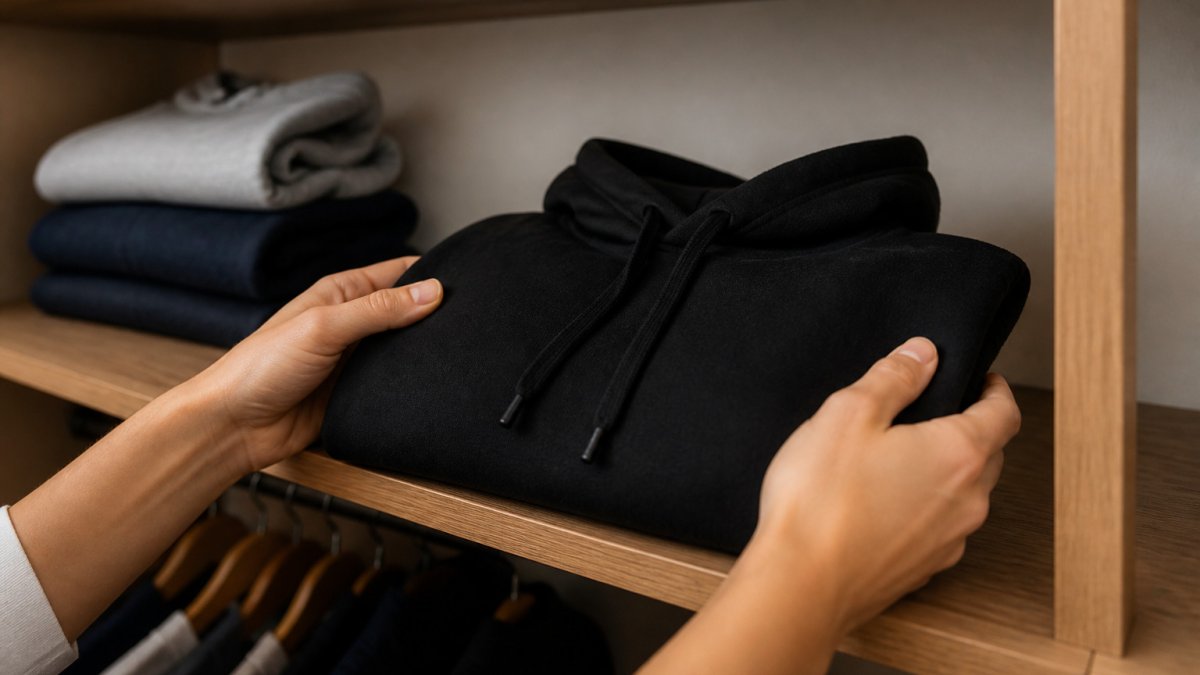
How to fold a hoodie step by step
- Lay the hoodie face down on a flat surface and smooth out wrinkles.
- Pull the hood inside out or tuck it neatly behind the back.
- Fold one sleeve across the back, then repeat on the other side.
- Fold the bottom hem up to meet the shoulders.
- Fold the whole piece in half, then in half again to fit the shelf.
2. Rolling Hoodies into Drawers
Rolling saves drawer space and reduces creasing in lightweight hoodies. Roll each piece tightly from the bottom hem up, then place the rolls side by side. Rolling works poorly for heavy fleece because it leaves deep compression lines that can take weeks to relax. Reserve this method for thin or stretchy fabrics.
3. Hanging Hoodies Without Distortion
Hanging is the fastest way to keep a hoodie visible and accessible, but it is also the method most likely to permanently stretch a shoulder or neckline.
When hanging is safe, and when it is not
- Safe: lightweight jersey, thin terry, and any hoodie under roughly 8-10 oz of fabric weight, hung on a hanger that matches the shoulder width.
- Risky: midweight fleece (10-13 oz) hung for more than a few days on a narrow hanger.
- Avoid: heavy fleece (14 oz and up), sherpa-lined hoodies, and any hoodie with a bulky hood, because the hood's weight adds downward pull at the back neckline.
Hanger choices that protect shape
- Wide, padded hangers, the padded shoulder spreads the load across the full shoulder seam instead of two points. This is the single biggest upgrade over wire or thin plastic hangers.
- Contoured wooden hangers, the curve follows the shoulder line and reduces the bump at the hanger tip, but only if the hanger width matches the hoodie's shoulder width.
- Fold-over-the-bar method, drape the hoodie over the lower bar of a hanger (or a padded hanger's crossbar) so the fold, not the shoulders, carries the weight. This is the best hanging option for midweight fleece because it removes shoulder load entirely.
Step-by-step: hanging a hoodie without shoulder bumps
- Zip or button the hoodie closed so the front edges stay aligned.
- Tuck the hood flat against the back so it does not pull the neckline forward.
- Slide the hanger in from the bottom, centering the shoulder seams on the hanger arms.
- Smooth the sleeves down and let them hang naturally, do not fold them over the bar, which creases the elbow area.
- Leave at least a finger's width between hanging hoodies so the fabric is not compressed against its neighbor.
Managing the hood, drawstrings, and zipper while hanging
- Hood: fold it flat behind the shoulders rather than letting it dangle; a dangling hood pulls the back neckline down.
- Drawstrings: tie them loosely or tuck them inside the hood so they do not catch on neighboring garments and yank the neckline.
- Zipper: close it before hanging to keep the front panels from twisting and to protect the zipper tape from abrasion.
If you have the closet depth, hanging is a fine short-term solution for lightweight hoodies. For anything midweight or heavier, the fold-over-the-bar method or flat shelf storage will preserve shape far better over a full season.
4. Stacking Hoodies in Bins and Cubbies
Clear storage bins and cubby organizers keep store hoodies visible and easy to find. Fold each piece first, then stand or stack them inside the bin. Avoid overfilling, since crushed hoods and compressed sleeves are the usual result. Cubbies work especially well for small closets because they combine shelf and drawer benefits.
5. Long-Term and Seasonal Storage
Off-season storage is where hoodies quietly lose their shape, not from a single bad fold, but from months of compression, trapped moisture, and creases that set into the fabric. The goal for long-term storage is different from daily storage: you are protecting shape and fabric integrity, not access.
Step 1: Clean and dry before storing
Never store a hoodie that has been worn, even lightly. Body oils, deodorant residue, and invisible sweat are what cause yellowing and musty odors over months. Wash according to the care label, then dry completely, including the hood's interior and the ribbing at the cuffs and hem, which hold moisture longest. A hoodie that feels dry on the outside can still be damp in the hood lining.
Men's Marvel Deadpool Splatter Icon Lightweight Hoodie →
Step 2: Choose the right container
- Breathable cotton or canvas storage bags, the best default. They let air circulate while keeping dust off.
- Clear plastic bins with vented lids, acceptable if the hoodie is fully dry and the bin is not sealed airtight.
- Vacuum-seal bags, avoid for hoodies. Compression crushes the loft of fleece and sets permanent creases in the hood and shoulders.
- Cardboard boxes, short-term only; cardboard can wick moisture and attract pests over a full season.
Step 3: Fold, do not compress
Fold each hoodie flat using the shelf method, then place it in the container with the hood flat against the back and the zipper closed. Stack no more than three hoodies per container, and put the heaviest at the bottom. Compression is the enemy of fleece loft: a hoodie crushed under a stack for six months will show flattened shoulders and a collapsed hood that may not recover.
Step 4: Control the environment
Store containers in a cool, dry, dark place, ideally a closet or under-bed area away from exterior walls, which can sweat in humid climates. Avoid attics and garages, where temperature swings cause condensation inside containers. Check each container every two to three months for moisture, odor, or pest activity, and air the hoodies out for a few hours before returning them.
Step 5: Bring them back gradually
When the season returns, unpack and hang or fold the hoodie in open air for a day before wearing. This lets any compressed fibers relax and any storage odor dissipate. If a crease has set, a light steam, not a hot iron, will relax it without flattening the fleece.
Choosing the Right Method for Your Closet and Hoodie Weight
No single method suits every hoodie.
Best for: people with a mix of heavy and lightweight hoodies who want one consistent routine.
The article's storage methods differ in what they suit and where they fall short, so the table below sets them side by side.
| Method | Best for | Key limit |
|---|---|---|
| Folding flat on a shelf | Most closets and all hoodie weights | Uses shelf space |
| Rolling into drawers | Lightweight or stretchy fabrics | Compression lines on heavy fleece |
| Hanging | Lightweight jersey, thin terry under 8-10 oz | Shoulder stretch on midweight fleece |
| Fold-over-the-bar hanging | Midweight fleece | Less suited to heavy fleece |
| Bins and cubbies | Small closets | Crushing if overfilled |
Pick Your Storage Method and Restock Your Lightweight Hoodies
If you are ready to restock, browse Sweatshirts for lightweight options, or explore Muscle Tee collections for printed styles.
Frequently Asked Questions
What is the best way to store a hoodie?
For most people, folding a hoodie flat and stacking it on a shelf keeps its shape best, because the weight stays spread across the body and sleeves instead of pulling on the shoulders. Fold along the sleeves first, keep the hood tucked inside, and avoid stacking more than five or six hoodies high so the bottom layers don't flatten or wrinkle.
Is it better to fold or hang hoodies?
Folding is usually better for hoodies. Folded hoodies also take up less room on shelves, which matters in small closets.
How do you fold a hoodie for storage?
Lay the hoodie face down on a flat surface and smooth out the wrinkles. Fold each sleeve across the back toward the center, then fold the bottom hem up to about a third of the way from the shoulders. Tuck the hood inside the body or fold it flat behind the collar. Finally, fold the body in half or thirds so it fits your shelf depth without pulling on the seams.
How should you store hoodies long term?
For long-term storage, wash and dry the hoodie completely first, since trapped moisture and body oils can stain fabric and attract pests. Fold it loosely, avoid creases on printed graphics, and store it in a breathable cotton bag or an open bin rather than sealed plastic. Keep the storage space cool and dry, and check items every few months.
