

Table of Contents
- What Is the 3-3-3 Rule in Fashion?
- How the 3-3-3 Style Challenge Works
- How to Create Outfits With 9 Pieces of Clothing
- How Many Outfits Can You Really Make? The 27-Outfit Math
- Capsule Wardrobe Outfit Ideas Built on the 3-3-3 Rule
- The Rule of Thirds in Fashion: A Different 3-3-3
- Limits of the 3-3-3 Rule and How to Adapt It
- Frequently Asked Questions
Last Updated: October 9, 2026
What Is the 3-3-3 Rule in Fashion?
The 3-3-3 rule in fashion limits a wardrobe to three tops, three bottoms, and three pairs of shoes, a small, flexible set you can mix into many outfits. At its core, the 3-3-3 rule is a constraint that forces better choices: fewer pieces, more combinations, faster decisions. This guide from HeroX Apparel breaks down how it works and where the method falls short.
The Three Meanings of 3-3-3
The phrase "3-3-3" covers three different ideas, and mixing them up causes confusion.
- The 3-3-3 style challenge: three tops, three bottoms, three pairs of shoes, worn in rotation for a set period, often a month.
- The rule of thirds in fashion: a proportion guideline borrowed from photography, where an outfit is divided into roughly one-third and two-thirds sections to balance the silhouette.
- The 3-3-3 wardrobe reset: a decluttering exercise where you pull three items to keep, three to donate, and three to repair or tailor.
Only the first involves nine pieces and a combination count. If a guide promises "27 outfits" then talks about proportion, it has switched definitions mid-article.
How the 3-3-3 Style Challenge Works
The 3-3-3 style challenge works by selecting nine items, wearing only those pieces for a defined window, and documenting the outfits you build. The point isn't deprivation, it's discovering how much variety a small, well-chosen set can produce.
Here's the standard structure:
- Pick a timeframe, usually 30 days.
- Choose three tops, three bottoms, and three pairs of shoes.
- Wear only those nine pieces for everyday dressing during the challenge.
- Photograph each outfit so you can see what actually worked.
- At the end, note which pieces you reached for constantly and which you avoided.
Most people find the avoided pieces were bought for a specific event rather than daily wear, a useful signal.
How to Create Outfits With 9 Pieces of Clothing
To create outfits with 9 pieces of clothing, you need a shared color base, compatible proportions, and a clear sense of your weekly dress codes.
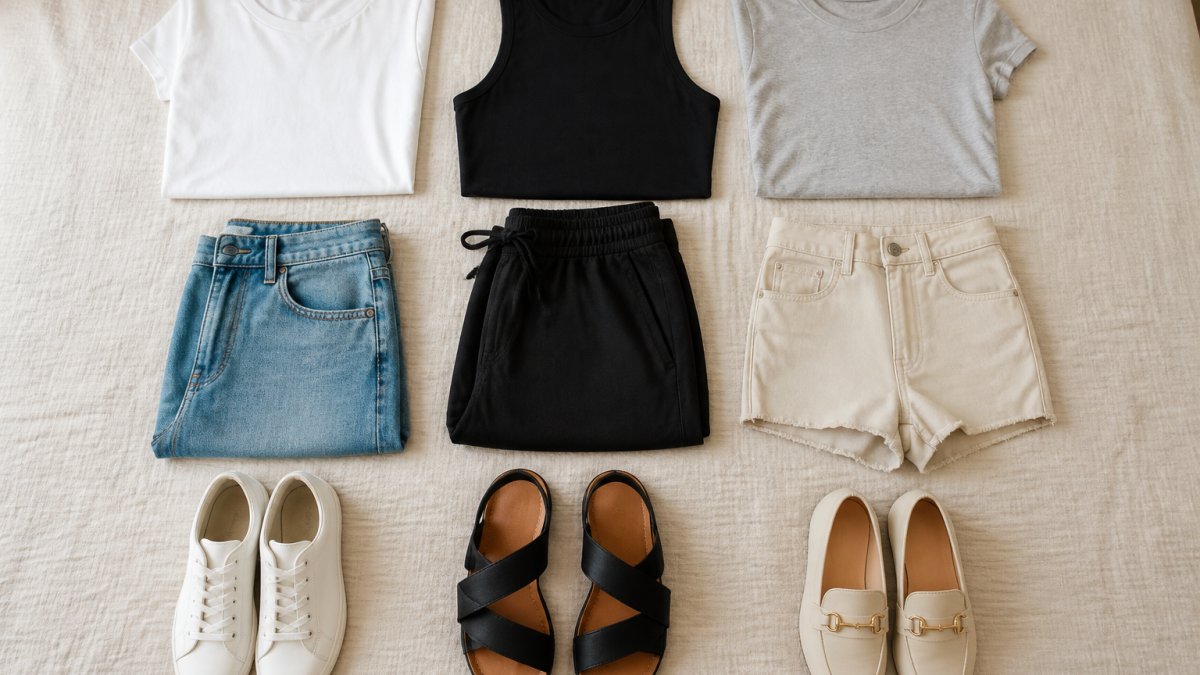
Selection Criteria for the Nine Pieces
Most guides tell you to pick three tops, three bottoms, and three shoes. They rarely explain how to choose pieces that actually mix. Use these criteria:
- Fit first: Every piece should fit you well right now, not after a diet, not after tailoring. A perfectly fitted plain tee beats an ill-fitting designer blouse.
- Color coordination: Choose a base neutral (black, navy, grey, beige, or white) and one accent color. Every top should work with every bottom. If a top only matches one bottom, it's a weak link.
- Fabric and season: For a 30-day challenge, pick fabrics appropriate for that month's weather. Cotton and linen for warm months, wool and flannel for cold. Avoid pieces that only work in a narrow temperature range.
A common pattern among people who succeed with the 3-3-3 rule: they choose pieces sharing the same two or three colors, then vary silhouette and texture, so every top works with every bottom.
A Visual Outfit Matrix for Your Nine Pieces
Below is a simple grid you can recreate with your own nine items. Label your tops T1-T3, bottoms B1-B3, and shoes S1-S3. Then fill in the combinations you would actually wear.
| B1 (e.g., dark denim) | B2 (e.g., tailored trouser) | B3 (e.g., relaxed skirt) | |
|---|---|---|---|
| T1 (neutral tee) | T1+B1+S1 (casual) | T1+B2+S2 (smart casual) | T1+B3+S1 (weekend) |
| T2 (solid color top) | T2+B1+S1 (everyday) | T2+B2+S2 (work) | T2+B3+S3 (dressy) |
| T3 (print or graphic) | T3+B1+S1 (fun casual) | T3+B2+S2 (edgy work) | T3+B3+S3 (statement) |
This matrix gives you nine starting points. Swap shoes to change formality: T1+B2+S1 turns a tailored trouser relaxed, T2+B1+S2 makes denim smarter. The goal isn't to wear all 27 combinations, but to see which 15-20 work for your life.
Realistic Combination Count: Why 27 Is Misleading
The 27-outfit figure assumes every top works with every bottom and shoe. In reality, compatibility, weather, and dress codes reduce that number:
- Raw combinations: 3 tops × 3 bottoms × 3 shoes = 27.
- Formality mismatches: A graphic tee with a formal trouser and dress shoes may look off. That eliminates roughly 3-5 combinations.
- Proportion clashes: A cropped top with a low-rise bottom may not flatter. Another 2-4 combinations gone.
Most practitioners get 15 to 22 genuinely wearable outfits from nine pieces, enough to dress for a month without repeating. The key is selecting pieces that maximize compatibility, not just count.
Adapting the Nine Pieces to Different Needs
The 3-3-3 rule isn't one-size-fits-all. How to adapt it:
- Climate extremes: Add outerwear and layering pieces outside the count. A coat, cardigan, or overshirt can change an outfit without adding a new combination.
- Work dress codes: If your week includes both casual and formal settings, keep a small separate set for specific occasions. Or expand to 4-4-4 for more range.
- Travel: Choose wrinkle-resistant fabrics and versatile shoes. A single pair of comfortable walking shoes can replace two if you plan to walk a lot.
The throughline: every piece should work with at least two others in the set. If it only works with one, replace it.
How Many Outfits Can You Really Make? The 27-Outfit Math
The 27-outfit figure comes from simple multiplication: three tops times three bottoms times three shoes equals 27 combinations.
Here's the realistic picture:
| Combination Type | Raw Count | Realistically Wearable |
|---|---|---|
| Top + bottom + shoes | 27 | 15-20 |
| Same top, different bottom/shoes | 9 | 6-8 |
| Same bottom, different top/shoes | 9 | 5-6 |
Not every combination works. A cropped top with a high-waisted tailored trouser may look sharp; the same top with a relaxed low-rise bottom may not.
The honest answer: you get 15 to 22 genuinely wearable outfits from nine pieces, still a full month of dressing without repeating.
Capsule Wardrobe Outfit Ideas Built on the 3-3-3 Rule
Capsule wardrobe outfit ideas built on the 3-3-3 rule start with a neutral base and layer personality on top. The nine-piece structure is essentially a micro-capsule, and the same logic scales up. Here are complete outfit combinations for different occasions.
Complete Outfit Examples for Different Occasions
Below are three complete 3-3-3 capsules, each with nine pieces and specific outfit combinations. Use these as templates, not rules.
Capsule 1: Neutral Core (for a casual office or everyday wear)
- Tops: white tee, black tee, striped long-sleeve tee
- Bottoms: dark denim, tailored trousers, relaxed midi skirt
- Shoes: white sneakers, black loafers, ankle boots
Outfit combinations:
- Work: striped tee + tailored trousers + loafers
- Weekend: white tee + dark denim + sneakers
- Dinner: black tee + midi skirt + ankle boots
Capsule 2: Fan-Forward (for expressing personality)
- Tops: graphic tee, plain sweatshirt, button-down shirt
- Bottoms: jeans, joggers, midi skirt
- Shoes: canvas sneakers, chunky sneakers, Chelsea boots
Outfit combinations:
- Concert: graphic tee + jeans + canvas sneakers
- Coffee run: sweatshirt + joggers + chunky sneakers
- Casual date: button-down + midi skirt + Chelsea boots
Capsule 3: Layered (for variable weather)
- Tops: tank top, long-sleeve tee, overshirt
- Bottoms: straight-leg jeans, tailored shorts, midi skirt
- Shoes: sandals, sneakers, ankle boots
Outfit combinations:
- Warm day: tank + shorts + sandals
- Cool evening: long-sleeve tee + jeans + ankle boots
- Layered: tank + overshirt + jeans + sneakers
Notice the third piece, the overshirt, jacket, or cardigan, changes the outfit without adding a new combination to the count. That's a key advantage.
How to Build Your Own Capsule
To build your own 3-3-3 capsule:
- Audit your closet. Pull out the pieces you wear most often. Identify your go-to colors and silhouettes.
- Choose a base neutral. Pick one neutral that dominates your wardrobe (black, navy, grey, beige, or white).
- Select three tops. One neutral, one solid color that flatters you, one with a print or graphic. Ensure all three work with all three bottoms.
- Select three bottoms. One denim, one tailored, one relaxed. Vary the rise and cut so the same top reads differently.
- Select three shoes. One everyday sneaker, one smarter shoe, one weather-appropriate option. Match the formality range of your bottoms.
- Test combinations. Lay all nine pieces out and physically pair them. If a combination doesn't work, swap a piece.
- Wear for a set period. Try 30 days. Photograph outfits to track what works.
Adapting the Capsule to Your Lifestyle
The 3-3-3 rule is flexible. How to adapt it:
- For travel: Choose wrinkle-resistant fabrics and versatile shoes. A single pair of comfortable walking shoes can replace two if you plan to walk a lot.
- For work dress codes: If your office requires business formal, replace one casual bottom with a suit pant and one sneaker with a heel or dress shoe. Keep the nine-piece count but adjust formality.
- For body and mobility needs: Prioritize comfort and ease of dressing. Elastic waists, magnetic closures, and soft fabrics can make the method accessible.
Limitations and Alternatives
The 3-3-3 rule works for many people, but it's not universal. It may not suit you if:
- You have a job with highly variable dress codes (e.g., construction site one day, client meeting the next).
- You live in a climate with extreme temperature swings within a month.
- You do laundry less than once a week, nine pieces will run out.
Alternatives: try a 4-4-4 capsule for more variety, use the 3-3-3 rule for workdays only with a separate weekend wardrobe, or add accessories (scarves, jewelry, bags) to expand variety without increasing the core count.
For fans who want their wardrobe to reflect what they love, the method pairs well with a few statement pieces. At HeroX Apparel, our graphic tees, hoodies, and sweatshirts featuring Marvel, Disney, Star Wars, and Pixar characters are built to be the personality piece in a small, coordinated set, and our stainless steel drinkware rounds out the look for everyday carry.
The Rule of Thirds in Fashion: A Different 3-3-3
The rule of thirds in fashion is a proportion guideline, not a wardrobe count. It divides the body visually into thirds so no single zone dominates.
This is separate from the nine-piece challenge, and the two get conflated constantly online. If you want to look taller or more balanced, the rule of thirds is the tool. If you want to simplify getting dressed, the nine-piece method is the tool.
Limits of the 3-3-3 Rule and How to Adapt It
The 3-3-3 rule breaks down in a few predictable situations. Acknowledging them upfront saves you from abandoning the method and blaming yourself.
- Climate extremes: nine pieces won't cover a week that swings from warm to freezing. Add outerwear and layering pieces outside the count.
- Dress codes: if your week includes both a casual office and formal events, nine pieces can't span that range. Keep a small separate set for specific occasions.
- Laundry reality: nine pieces means frequent washing. If you don't do laundry weekly, the rotation runs dry.
Adaptations that work: expand to 4-4-4, keep the nine for workdays only, or run the challenge for two weeks instead of a month to test whether it suits you.
For fans who want their wardrobe to reflect what they love, the method pairs well with a few statement pieces. At HeroX Apparel, our graphic tees, hoodies, and sweatshirts featuring Marvel, Disney, Star Wars, and Pixar characters are built to be the personality piece in a small, coordinated set, and our stainless steel drinkware rounds out the look for everyday carry.
Frequently Asked Questions
What is the 3-3-3 rule in fashion?
The 3-3-3 rule means choosing three tops, three bottoms and three pairs of shoes, then wearing only those nine items for a set period, often three months. Every top can pair with every bottom and every pair of shoes, so the nine pieces produce up to 27 different outfits. It is a simple outfit formula for people who want variety without a full closet.
How many outfits can you make with the 3-3-3 rule?
In theory, nine pieces give you 27 combinations: 3 tops x 3 bottoms x 3 shoes. In practice, you will wear fewer than that. Weather, dress codes and personal taste rule some pairings out, so most people realistically rotate through 15 to 20 outfits. That is still more than enough variety for a three-month wardrobe.
What clothing items should you choose for a 3-3-3 wardrobe?
Pick pieces that share a coordinating color palette and suit your daily routine. For tops, try a plain tee, a button-down and a knit sweater. For bottoms, a pair of jeans, tailored trousers and a skirt or second denim cut. For shoes, neutral sneakers, boots and a flat or loafer. Keep prints minimal so everything mixes and matches.
Can you use the 3-3-3 rule with clothes you already own?
Yes, and it is the easiest way to start. Pull everything out of your closet, then select the nine pieces you reach for most often. Check that each top works with at least two bottoms and each pair of shoes suits multiple outfits. Anything left over goes into storage rather than the bin, so you can swap pieces in later.
What is the difference between the 3-3-3 rule and a capsule wardrobe?
A capsule wardrobe is usually 20 to 40 items covering a whole season, including outerwear and accessories. The 3-3-3 rule is a much smaller exercise: just nine core pieces worn for a set period. Think of it as a capsule wardrobe in miniature, useful as a trial run before you commit to a larger closet edit.
How does the 3-3-3 style challenge work?
The challenge asks you to live with nine items for a fixed window, commonly three weeks or three months. You photograph or note each outfit you build, then review what worked at the end. The goal is to prove to yourself how many outfits a limited wardrobe can produce, and to spot the pieces you never actually wear.
Does the 3-3-3 rule work for plus sizes and different body types?
The rule is about quantity and coordination, not body shape, so it adapts to any size. Choose silhouettes you already feel good in and keep the color palette tight. If you layer often, count a cardigan or jacket as one of your three tops. Adjust the shoe count to your needs, for example two flats and one boot.
Building a wardrobe that actually works takes more than a formula. It takes pieces that hold up, fit well, and say something about who you are. HeroX Apparel makes apparel for fans who want their style to reflect their fandom without sacrificing quality, from character tees and hoodies to branded drinkware. Get started with HeroX Apparel and build a small rotation you'll actually reach for.